
Most finance leaders know pay-and-chase audit models are reaching their limits—but redesigning when and how controls engage feels risky when reimbursements, trust, and speed are on the line. Tighten controls too aggressively, and approvals stall. Leave things as they are, and risk signals arrive only after money has already moved.
Caught between disruption and exposure, many teams stay stuck with models that struggle to keep up with the volume and velocity of modern spend.
The way forward isn’t heavier enforcement or more reviewers. It’s shifting control to the moments where it can still change behavior.
That’s why we’ve designed a practical 90-day path to shift fraud prevention earlier in the expense lifecycle—showing how intelligent compliance replaces pay-and-chase reviews with timely intervention, clearer signals, and scalable control.
The shift from reactive audit to intelligent compliance
Intelligent compliance embeds fraud prevention into the flow of spend, rather than relying on after-the-fact enforcement.
Instead of a single post-submission checkpoint, Emburse Assurance applies intelligence across the expense lifecycle—surfacing issues earlier, guiding corrections in context, and escalating only higher-risk cases for human review. Insights then feed continuous improvement over time.
The Intelligent Compliance Framework
Built around four pillars, this framework shows what Emburse Assurance looks like in action:
Proactive Protection
Emburse Assurance reduces pay-and-chase by surfacing risk at the point of entry before expenses ever reach approval. Proactive alerts prompt employees to fix incomplete or incorrect expenses in real time, cutting exposure without slowing approvals.
Effortless Compliance
Most leakage stems from process friction and policy confusion, not malicious intent. Emburse Assurance delivers real-time, in-workflow guidance that flags policy issues and missing details pre-submission. Employees can correct errors immediately, while approvals keep moving.
Human-Backed Intelligence
Emburse Assurance validates expenses at scale, surfacing only higher-risk anomalies that require human judgment.
Actionable Insights
Unified dashboards reveal fraud patterns, policy gaps, and emerging risk signals, translating spend data into clear insights that finance teams can use to continuously strengthen controls.
How intelligent compliance works at every step
Key callout process flow:
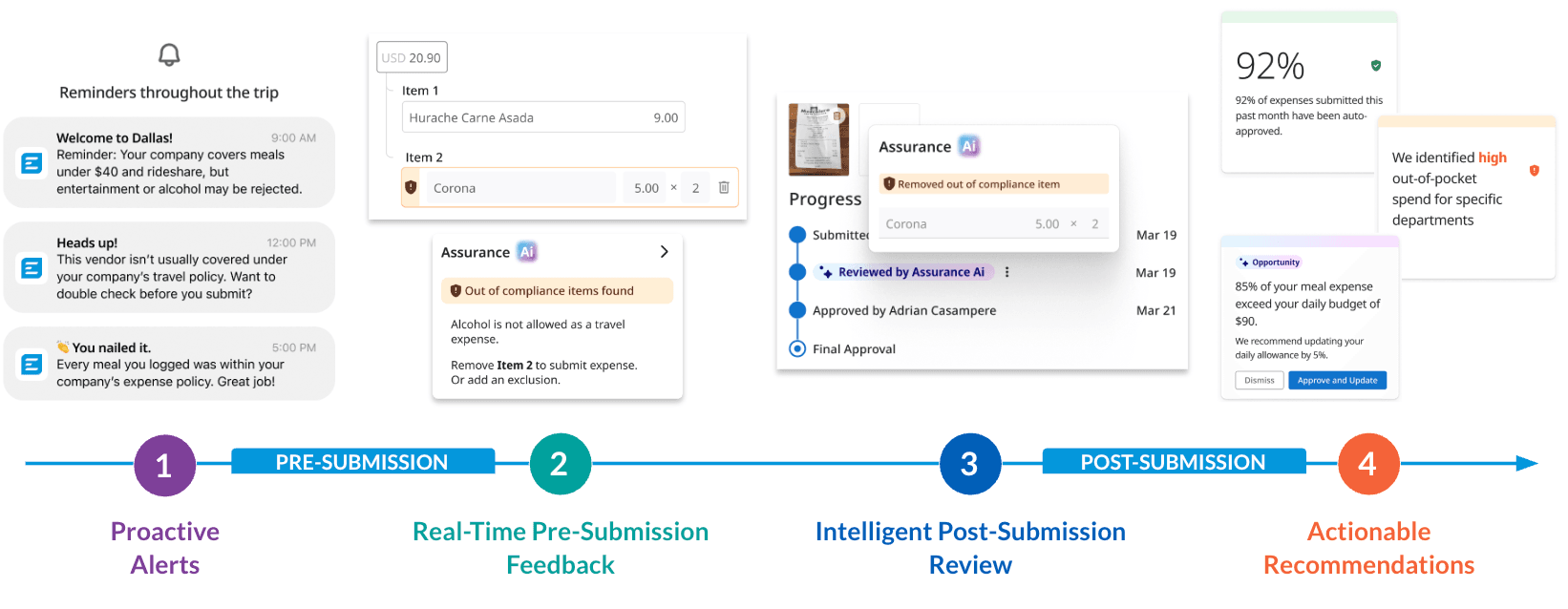
Step 1: Proactive alerts
- Notify employees about incomplete or incorrect receipts for on-the-spot fixes
Step 2: Real-time pre-submission feedback
- Identifies policy issues or missing details within the workflow as expenses are created
- Prompts immediate correction pre-submission, reducing downstream clerical noise
Step 3: Intelligent post-submission review
- AI validates expenses at scale and flags complex or high-risk anomalies for human review
- Risk scoring helps reviewers know which exceptions to prioritize
Step 4: Actionable recommendations
- AI-powered insights surface high-risk reports, recurring patterns, and policy gaps so finance teams can continuously optimize controls
Implement intelligent compliance with Emburse Assurance in 90 days
This 90-day roadmap shows how finance teams can shift from reactive cleanup to proactive control with Emburse Assurance while keeping spend moving.
Diagnose (Days 1–30): Where are we actually exposed?
Before introducing new controls, finance teams need a clear understanding of where risk actually lives. This phase focuses on separating true fraud exposure from everyday clerical noise.
- Use historical spend data to identify where policy exceptions, rework, and friction concentrate
- Create clean inputs so downstream intelligence focuses on real exposure, not noise
Design (Days 31–45): Where does pre-submission intervention work best?
With a baseline in place, the next step is choosing where to act so Emburse Assurance is applied where early guidance is most effective.
- Scope Emburse Assurance intentionally around high-impact use cases
- Apply pre-submission guidance where it reduces friction and exposure
Deploy & Learn (Days 46–75): How is Emburse Assurance reducing risk in live environments?
This phase is where employees interact with Emburse Assurance for the first time, allowing teams to observe how employees respond, which issues resolve early, and where human judgment still adds value.
- Activate Emburse Assurance to provide in-workflow guidance and evaluate expenses at scale
- Pilot the model to observe what drives correction, where confusion remains, and what still escalates
Scale & Optimize (Days 76–90): Are our controls compounding value or adding friction?
By this stage, Emburse Assurance is already operating at scale, informed by pilot data. The focus shifts from deployment to improvement, which helps reduce noise, strengthen signals, and keep controls aligned with how spend actually behaves.
- Use dashboards to track patterns across risk, exceptions, and outcomes
- Adjust policy intent, routing, and control strength based on observed behavior
Intelligent compliance in action
Pace University managed roughly 1,000 expense reports and card reconciliations each month across a highly decentralized workforce. While expenses were automated, audits relied on manual spot checks and disconnected tools, resulting in inconsistent flags, frequent rework, and hours of AP clerical effort each month.
By unifying audit activity within the expense workflow, Pace removed manual intervention from routine review and focused attention only when issues persisted, achieving:
- 100% elimination of manual audits
- 75% reduction in spot-checking
- 50%+ reduction in audit time
Emburse Assurance: Fraud prevention as financial infrastructure
Audit still matters, and so does human judgment. Intelligent compliance changes where they apply—bringing scrutiny earlier in the spend journey and reserving deeper review for moments that truly carry risk.
Emburse Assurance enables this shift by embedding intelligence directly into the flow of spend—turning live expense activity into actionable signals that help finance teams intervene earlier, reduce clerical noise, and keep oversight aligned with how spend actually moves.
What matters now is how your current audit model compares to modern, intelligence-led fraud prevention.
If you’d like to see how your organization matches up, book a tailored fraud risk consultation. Our expert team can help identify where risk and rework surface in your spend environment, and where earlier intervention could reduce exposure without adding friction.
For a deeper view of how AI is reshaping fraud and waste prevention, explore our whitepaper, Fraud and Waste Prevention in an AI-Enabled Spend Landscape.