


AI adoption is expanding across enterprise customers, industries, regions, workflows, and vendor categories, even as AI remains a small share of total spend.
Artificial intelligence is no longer a peripheral experiment in enterprise finance. New analysis of Emburse Enterprise customer data shows that AI usage is becoming more consistent across customers, industries, regions, and workflows.
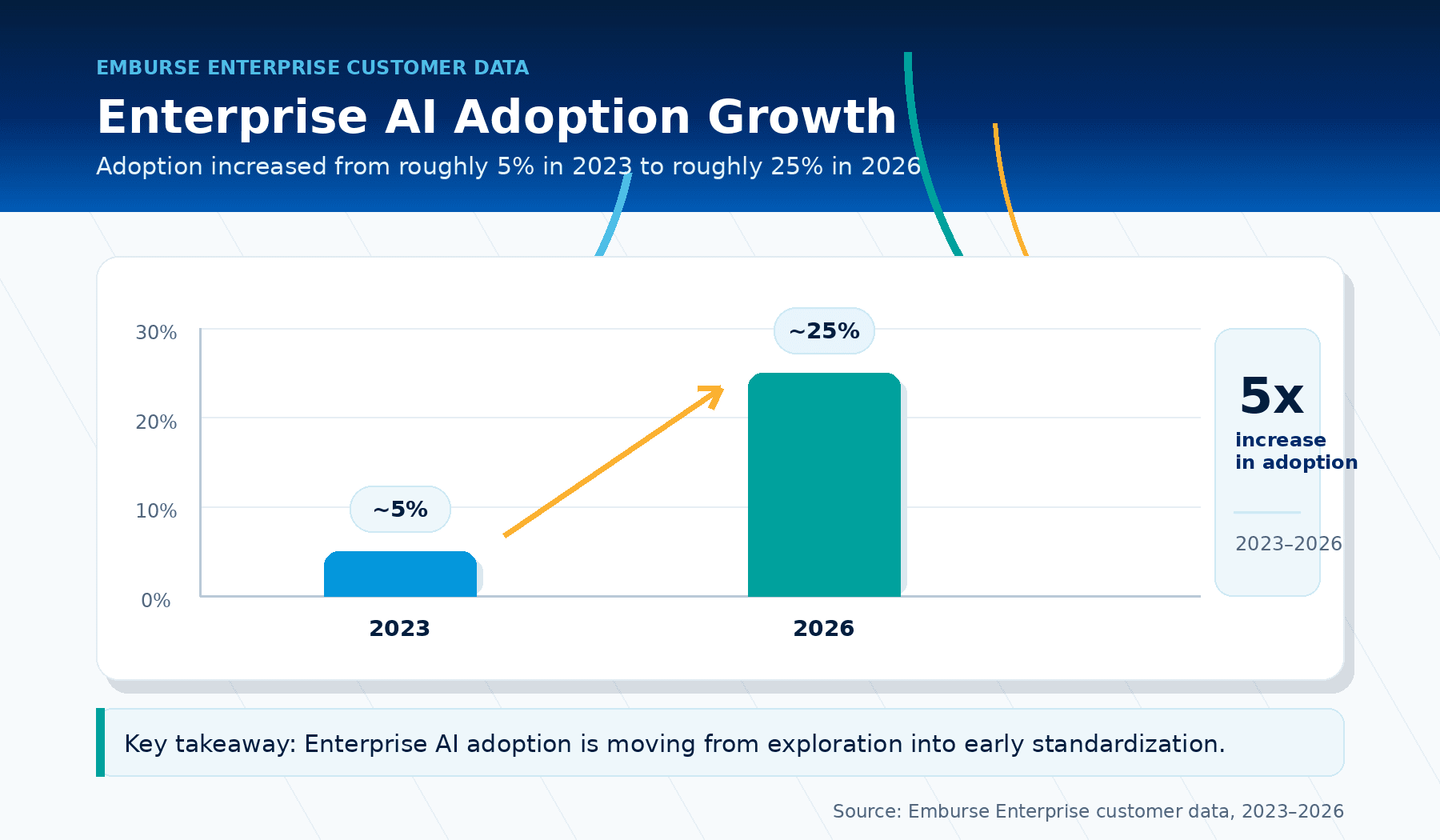
From 2023 to 2026, Enterprise customer adoption increased from roughly 5% to roughly 25%. During the same period, AI spend increased by orders of magnitude, with the strongest acceleration occurring between 2024 and 2025.
AI still represents less than 0.002% of total enterprise spend. But the more important signal is behavioral: usage is recurring, adoption is broadening, and AI vendor activity is expanding beyond single-tool experimentation into multi-provider ecosystems.
Enterprise AI spend has reached an inflection point. View the full AI index here.
What the data shows
Emburse Enterprise customer data points to a clear shift in how AI is being adopted and used across organizations.
Key findings include:
- Enterprise customer adoption increased from roughly 5% in 2023 to roughly 25% in 2026
- AI spend increased by orders of magnitude from 2023 to 2026
- Growth accelerated most between 2024 and 2025
- U.S. AI spend penetration is roughly 3–4x higher than non-U.S. penetration
- Information / Education and Professional Services show the strongest adoption patterns
- Invoice-driven AI adoption reflects more centralized, procurement-led buying
- Expense-driven AI adoption reflects employee-led experimentation and organic team usage
- Multi-vendor AI stacks are emerging, with organizations increasingly using model providers, infrastructure tools, and specialized AI vendors together
This analysis is based on anonymized Emburse Enterprise customer spend data from 2023 through 2026. The data reflects observed AI-related vendor spend across expense and invoice workflows and should be read as a behavioral indicator of enterprise AI adoption, not as a full measure of every AI tool used inside an organization.
How much has enterprise AI adoption grown?
Enterprise AI adoption has grown steadily from 2023 to 2026, based on Emburse Enterprise customer data.
From 2023 to 2026:
- Enterprise customer adoption increased from roughly 5% to roughly 25%
- Growth has been consistent year over year, not episodic
- Adoption is no longer limited to early adopters
This pattern suggests AI is moving from exploration into early standardization. More organizations are not only testing AI tools, but using them often enough for adoption to show up consistently in spend data.
For finance leaders, this matters because AI adoption is no longer contained to a small group of technical teams or isolated innovation budgets. It is beginning to appear across the everyday financial workflows that shape how spend is approved, categorized, reimbursed, and governed.
Is enterprise AI spend growing as fast as adoption?
AI spend is increasing alongside adoption, but the two signals are not moving at the same pace.
Key observations include:
- AI spend increased by orders of magnitude from 2023 to 2026
- Growth accelerated most between 2024 and 2025
- Spend growth lags adoption, indicating early-stage scaling dynamics
This pattern is consistent with the behavior often seen in emerging technology adoption, where usage expands before budgets fully scale. Employees and teams may begin testing AI tools organically, while finance, procurement, and IT later determine which tools should be standardized, governed, consolidated, or expanded.
That lag between adoption and spend is important. It suggests many organizations are still in the early stages of figuring out how AI should be funded, managed, and operationalized at scale.
Where is enterprise AI spend most advanced?
AI adoption is most advanced in the United States, where enterprise ecosystems and vendor access are more mature.
In Emburse Enterprise customer data:
- U.S. AI spend represents roughly 0.0015% of total spend
- Non-U.S. AI spend represents roughly 0.0004% of total spend
That represents a 3–4x difference in relative penetration.
The data suggests geography plays a meaningful role in enterprise AI adoption, with U.S. organizations showing more advanced spend penetration than non-U.S. organizations. This may reflect differences in vendor availability, market maturity, procurement patterns, and how quickly organizations are incorporating AI tools into day-to-day workflows.
Which industries show the strongest AI adoption?
AI adoption varies by industry, with the strongest penetration appearing in decentralized, knowledge-driven sectors and slower emerging adoption in more regulated industries.
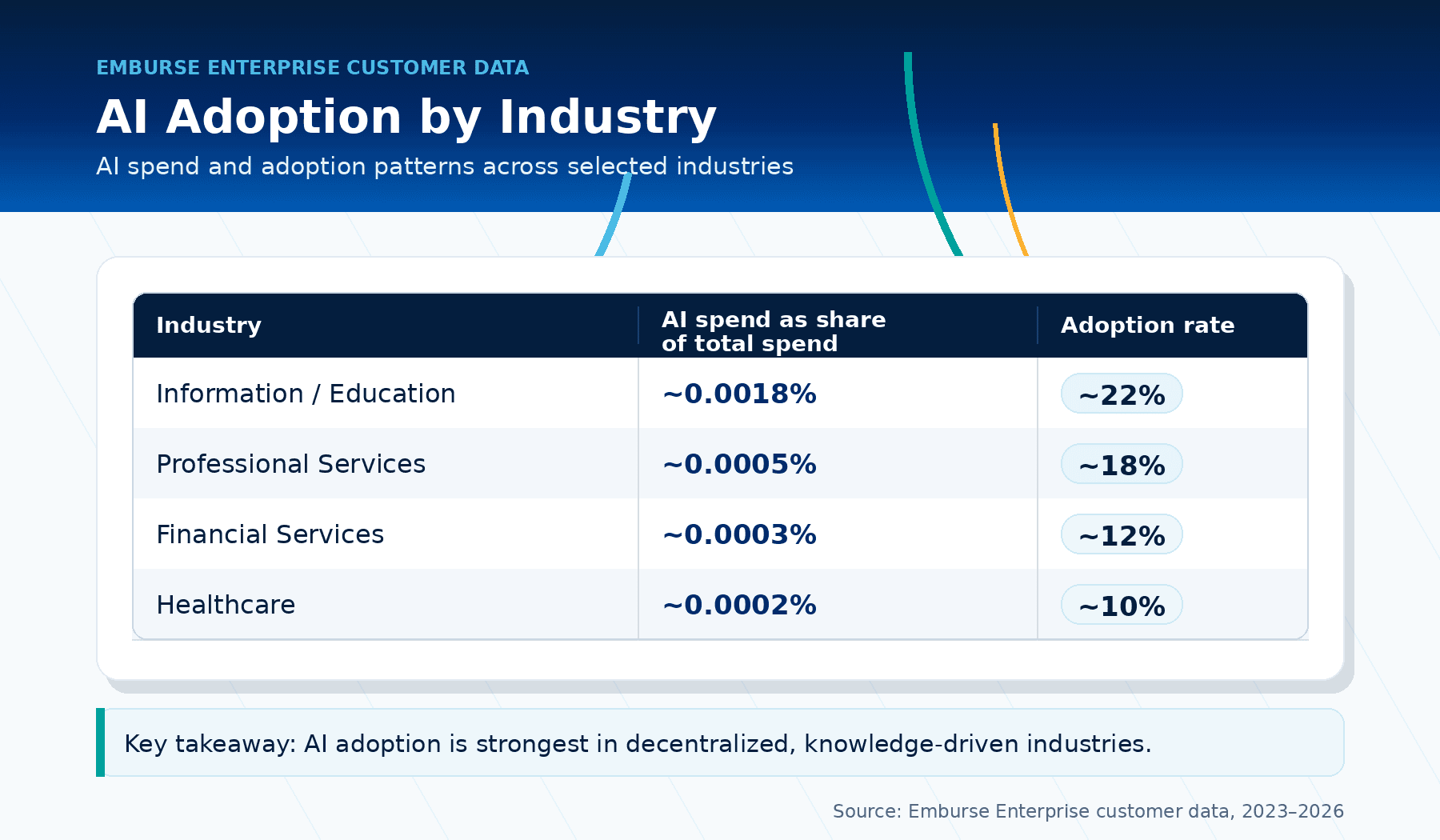
The data points to three takeaways:
- AI adoption is strongest in decentralized, knowledge-driven industries
- More regulated sectors show slower but emerging adoption patterns
- AI usage is appearing through both invoice-driven and expense-driven channels
These patterns suggest AI is taking hold fastest where knowledge work is distributed across teams and where employees may have more opportunities to test new tools in daily workflows. In more regulated environments, adoption is emerging more gradually, likely reflecting greater scrutiny around governance, compliance, and data handling.
How is AI entering the enterprise?
AI is entering the enterprise through two distinct channels: invoice-driven adoption and expense-driven adoption.
These channels show different buying behaviors, governance patterns, and scaling dynamics.
Invoice-driven adoption reflects top-down AI usage
Invoice-driven AI adoption reflects more centralized, top-down buying behavior.
Observed signals include:
- Adoption: roughly 20%
- AI spend: roughly 0.0012%
This pattern reflects procurement-led adoption, vendor-based integration, and more defined use cases. In these environments, AI tools are more likely to be evaluated, approved, and scaled through formal business workflows.
Invoice-driven adoption often shows where AI is being intentionally purchased and integrated into business operations. These tools may be tied to specific vendors, contracts, departments, or approved business processes.
Expense-driven adoption reflects bottom-up AI usage
Expense-driven AI adoption reflects more distributed, bottom-up usage.
Observed signals include:
- Adoption: roughly 15%
- AI spend: roughly 0.0008%
This pattern reflects individual employee usage, experimentation with AI tools, and organic growth across teams.
Expense-driven adoption is a different signal. It may show where employees are independently adopting AI tools to support their own work before those tools are fully standardized by the organization. This does not make the spend less important. In many cases, it makes it more important for finance leaders to understand.
Bottom-up AI usage can spread quickly across teams, departments, and cost centers. Without visibility, organizations may struggle to understand which tools are being used, how often they are being expensed, and where governance may be needed.
Why combined invoice and expense visibility matters for AI spend
The highest levels of AI adoption appear among customers with visibility across both invoice and expense activity.
In this group:
- Adoption exceeds roughly 25%
- AI usage appears across centralized and decentralized workflows
- Activity is more consistent and recurring
This suggests that organizations with broader spend visibility are better positioned to see how AI is being adopted across the business. Invoice data can reveal top-down vendor adoption, while expense data can reveal bottom-up employee usage.
That distinction matters because AI adoption is not happening through one clean path. Some tools enter through procurement. Others begin with individual employees. Some are billed centrally. Others show up in expense reports. Some become standardized quickly. Others remain distributed across teams.
To understand enterprise AI adoption, finance leaders need visibility into both sides of the pattern.
AI usage is spreading beyond technical teams
A key signal of maturity is the growth in unique expense owners using AI.
The data shows that:
- AI usage is spreading beyond technical teams
- More employees are incorporating AI into daily workflows
- Repeat usage is increasing across individuals and departments
This suggests AI is evolving into a general-purpose enterprise capability rather than remaining a niche technical tool.
For finance leaders, that shift matters because AI spend may now appear across more teams, more cost centers, and more approval paths. What may have started as experimentation inside technical functions is becoming a broader operating pattern across the business.
The more distributed AI usage becomes, the more important it is to understand where the spend originates, how frequently it recurs, and which vendors are becoming embedded in daily work.
Why small AI spend still matters
AI remains a small share of total enterprise spend, but it is no longer invisible.
Despite strong growth signals:
- AI still represents less than 0.002% of total enterprise spend
- Most organizations are still in the early stages of scaling
The critical shift is not share of spend. It is behavioral integration.
AI usage is recurring. Adoption is broadening. AI activity is appearing across customers, workflows, users, and vendors.
That is why enterprise AI adoption has reached an inflection point. The spend may still be small compared to total enterprise spend, but the behavior behind it is changing quickly.
AI vendor adoption is shifting from single tools to multi-provider stacks
One of the clearest signals in the Emburse Enterprise AI Index is not only how much AI is being used, but how many types of AI vendors are appearing across enterprise spend.
The data shows a shift from isolated tool usage toward multi-provider AI ecosystems. Enterprises are not only paying for individual AI applications. They are beginning to build AI stacks that include model providers, infrastructure layers, and specialized capabilities.
Model providers are leading the ecosystem
Model providers remain the foundation layer of enterprise AI adoption.
In Emburse Enterprise customer data, OpenAI and Anthropic represent the highest usage across customers. In the most recent several months, Anthropic has overtaken OpenAI as the top AI vendor among Emburse Enterprise expense customers.
These vendors form the foundation layer for enterprise AI adoption. Their presence is consistent across both invoice and expense channels.
The interpretation is clear: enterprises appear to be standardizing around a small number of core model providers as the entry point into AI.
Infrastructure and tooling layers are growing quickly
Infrastructure and tooling vendors are also showing strong adoption. Vendors such as Hugging Face, Pinecone, Together AI, and Fireworks AI support functions such as:
- Model hosting
- Retrieval and vector search
- Orchestration and scaling
This suggests AI usage is moving beyond simple API access toward production-grade infrastructure.
As organizations mature, they are not only using AI tools. They are investing in the systems that help AI become more reliable, scalable, searchable, and integrated into existing workflows.
Specialized AI capabilities are emerging
Specialized AI vendors are also appearing in enterprise spend data. Vendors such as ElevenLabs and Deepgram point to growing interest in:
- Voice AI
- Speech processing
- Modality-specific AI capabilities
These vendors are more likely to appear through expense-driven adoption, where individual teams test AI capabilities for specific use cases before they become centralized purchases.
This suggests AI adoption is expanding beyond text-based tools into more specialized use cases.
Multi-vendor AI stacking is becoming more common
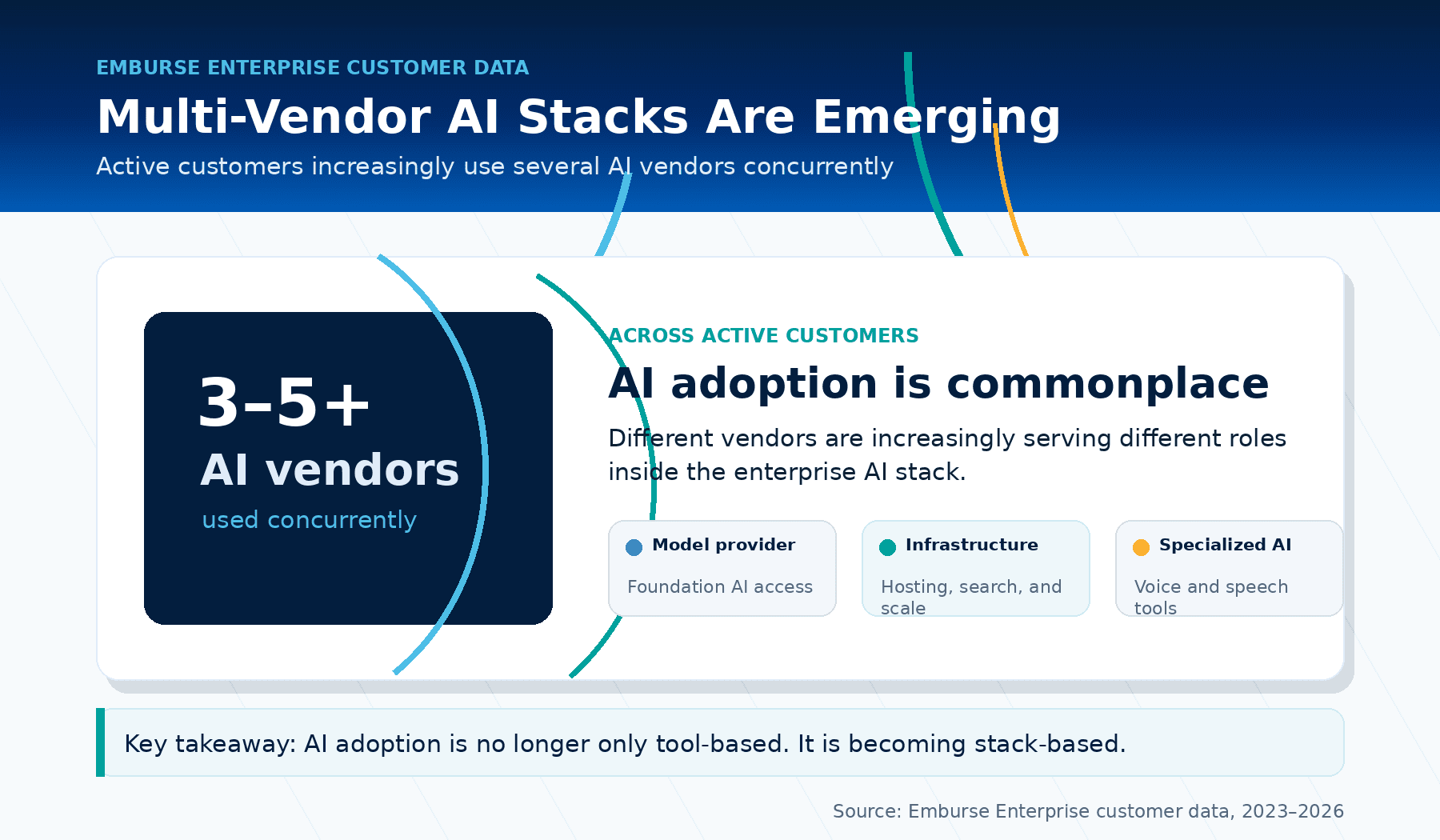
The data also shows evidence of multi-vendor AI stacking.
Across active customers, it is increasingly common to see three to five or more AI vendors used concurrently. Different vendors appear to serve different roles, including:
- Model provider
- Infrastructure layer
- Specialized capability
This is one of the most important signals in the data.
AI adoption is no longer only tool-based. It is becoming architecture-based.
Organizations are not simply asking whether they should use one AI vendor. They are beginning to assemble AI ecosystems that serve different needs across teams, workflows, and business processes.
What enterprise AI spend means for finance leaders
Enterprise AI spend is still early, but it is becoming harder to ignore.
For finance leaders, the question is no longer simply whether employees are using AI. The more important questions are:
- Where is AI spend entering the organization?
- Which teams are driving adoption?
- Which vendors are becoming recurring expenses?
- Which tools are being purchased centrally?
- Which tools are being expensed individually?
- Where does AI spend create value?
- Where does AI spend create risk, duplication, or governance gaps?
AI adoption is moving quickly. Finance visibility needs to move with it.
When AI spend appears across both invoices and employee expenses, traditional reporting may not be enough. Organizations need a clearer view of how AI usage is spreading, where it is becoming embedded, and what controls are needed as adoption scales.
Learn how Emburse Expense Intelligence provides the infrastructure layer for modern finance.
FAQ: Enterprise AI spend and adoption
What is enterprise AI spend?
Enterprise AI spend refers to business spending on AI-related vendors, tools, model providers, infrastructure, and specialized AI capabilities. In Emburse Enterprise customer data, this spend appears across both invoice-driven and expense-driven workflows.
How much has enterprise AI adoption grown?
In Emburse Enterprise customer data, AI adoption increased from roughly 5% in 2023 to roughly 25% in 2026.
Is AI a large share of total enterprise spend?
No. AI still represents less than 0.002% of total enterprise spend in the data analyzed. The more important signal is that usage is recurring, adoption is broadening, and AI spend is appearing across more workflows and users.
Which industries show the strongest AI adoption?
Information / Education and Professional Services show the strongest AI adoption patterns in the current analysis, with Information / Education at roughly 22% adoption and Professional Services at roughly 18%.
How is AI entering the enterprise?
AI is entering the enterprise through two main paths: invoice-driven adoption and expense-driven adoption. Invoice-driven adoption tends to reflect centralized, procurement-led buying. Expense-driven adoption tends to reflect employee-led experimentation and organic team usage.
What does multi-vendor AI stacking mean?
Multi-vendor AI stacking means organizations are using several AI vendors at the same time, often for different purposes. One vendor may provide foundation models, another may support infrastructure, and another may deliver specialized capabilities such as voice AI or speech processing.
Why does AI spend visibility matter?
AI spend visibility matters because AI adoption can enter the organization through multiple channels. Some tools are purchased centrally through invoices, while others are adopted by employees and submitted through expenses. Without visibility into both paths, finance leaders may miss how quickly AI usage is spreading across the business.