


AI spend inside the enterprise has stopped behaving like an experiment. The Emburse AI Index tracks anonymized, aggregated expense and invoice data across our enterprise customer base, and the latest data points to a business tool, not a science project. Nearly half of eligible enterprise customers now carry recurring AI spend, the customers already using AI are investing in it faster than new customers are adopting it, and the vendor landscape is widening and consolidating at the same time. For finance leaders, the question is no longer whether to allow AI. It’s how to govern spend that already behaves like a core software category.
That spend isn’t landing in some new, unfamiliar place. It’s showing up in the same two channels you already manage every day, employee expense reports and AP invoices, which means it’s already sitting inside your existing controls whether you’ve spotted it yet or not.
The data at a glance
- Adoption is mainstream. 48% of eligible enterprise customers show recurring AI spend as of the latest month, up from 37% three years ago. Across the full study period, 45% of customers met Emburse’s threshold for sustained AI adoption.
- Spend concentrates in two categories. Foundation models and APIs account for 44.6% of AI category spend. AI agents and workflow apps add another 37.5%. Together, those two categories make up 82% of the AI budget.
- A new vendor leads, again. Anthropic overtook OpenAI as the top AI vendor by enterprise expense spend in the most recent quarter. More than 90% of that growth came from companies with 5,000 or more employees.
- Most customers still use several vendors. Roughly half of active AI customers now use two or more named vendors a month, and that share keeps climbing.
From AI approval to AI control
The first phase of enterprise AI ran on access and experimentation. Employees signed up for tools on their own. Business units bought whatever solved their immediate problem. Finance and IT approved budget after the fact more often than before it.
That phase is ending. The organizations pulling ahead aren’t necessarily the ones using the most AI. They’re the ones treating AI as a core software category, with ongoing governance, a real budget process, and active vendor management, instead of a discretionary innovation line. AI has entered its operating era, and it now needs the same executive discipline as any other enterprise platform.
For teams already responsible for travel, expense, AP, and card spend, that’s not a new job. It’s the same governance muscle you already apply to every other category, pointed at one that’s moving faster than the rest.
How fast is enterprise AI adoption growing?
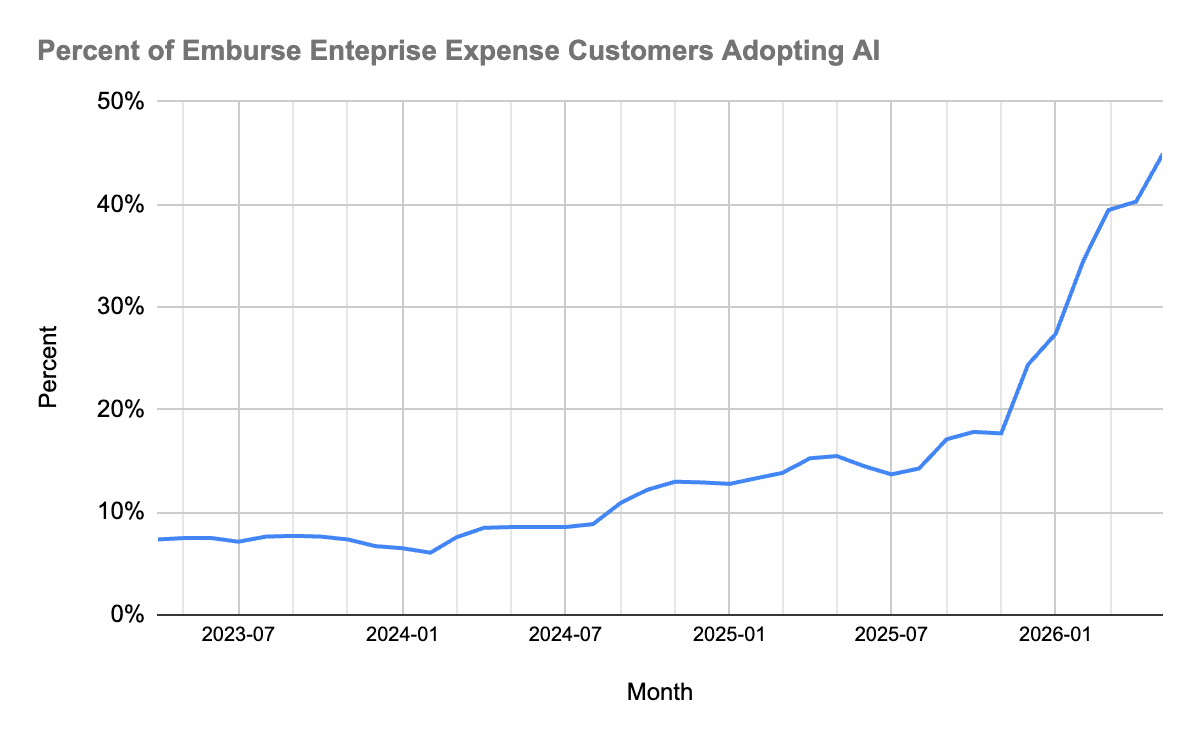
Recurring AI adoption has climbed from 37% of eligible enterprise customers in mid-2023 to 48% today, with the sharpest acceleration in the second half of 2025. That’s not one strong month. It’s three years of steady, compounding growth.
Two things stand out inside that number. First, AI is walking into the business through two doors at once. Employees expense AI tools on their own, and procurement teams sign enterprise contracts, sometimes for the same tools the employees already found. Second, the active AI customer base already skews toward repeat use. Returning customers, not first-time trials, make up most active AI spend each month.
Leaders should read that as permission to stop treating AI as an experiment and start asking which teams depend on it, which workflows it touches, and whether it’s actually working.
Is AI investment growing faster than adoption?
Yes, and that gap matters more than the adoption number by itself. While the share of companies with any AI spend keeps rising steadily, the companies already using AI are expanding their investment even faster. The median AI customer still spends modestly. The top decile and top percentile of spenders are pulling away from that median, evidence that the most mature organizations aren’t just buying more tools. They’re building deeper, more permanent workflows around the ones that work.
That’s the real signal for finance leaders. AI maturity isn’t just whether a company shows up on the spend list. It’s how much of the organization depends on AI, and how fast that dependency is growing.
Where is the AI budget actually going?
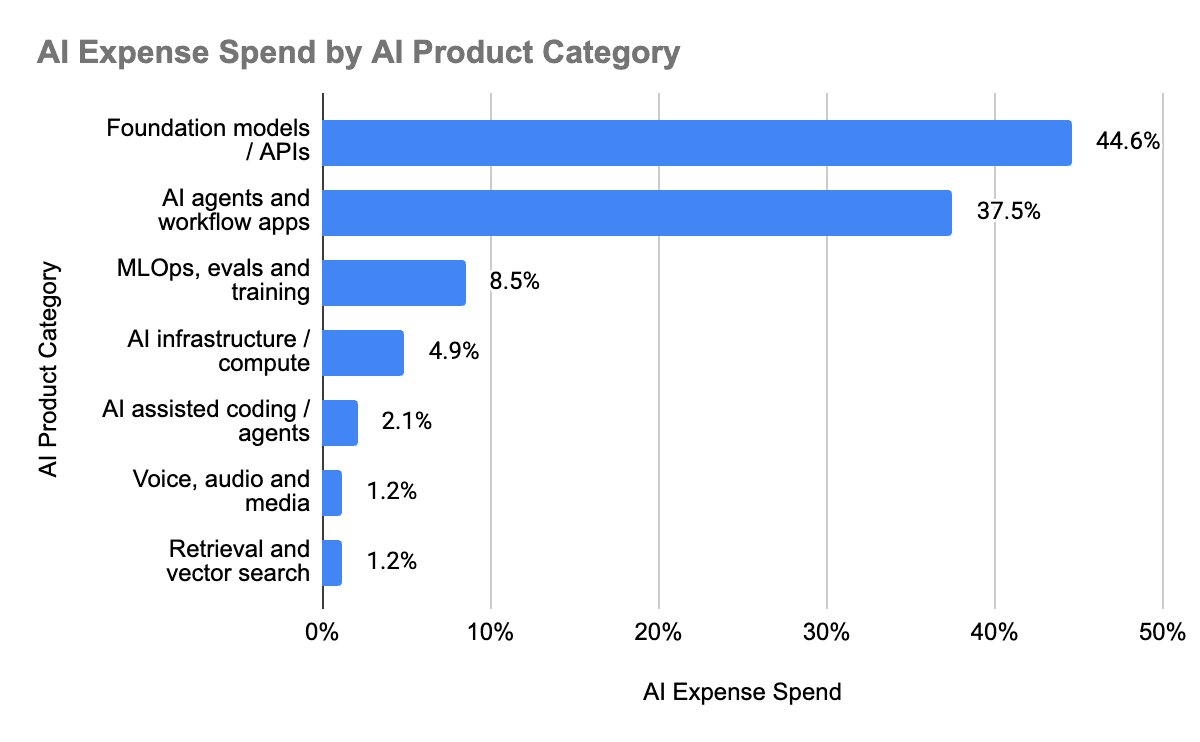
AI budgets are no longer just chat subscriptions. Foundation models and APIs account for 44.6% of category spend, the single largest line. AI agents and workflow applications add another 37.5%. Together, those two categories capture 82% of every AI dollar tracked in the index. The rest, including AI infrastructure, coding agents, retrieval tools, and media generation, is real but still small.
That mix will keep moving. Category share has already rotated month to month as use cases mature, so locking a budget around a single AI category too early is a mistake. Review AI spend quarterly, and separate experimentation from production workflows that need reliability, data controls, and a real vendor commitment.
Is the AI vendor market consolidating or fragmenting?
Both, at the same time, and that’s exactly what makes it hard to manage.
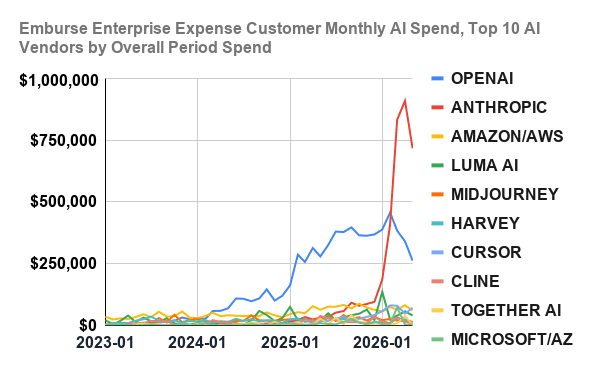
Start with the leaderboard. Anthropic overtook OpenAI as the top AI vendor by total enterprise expense spend in the most recent quarter, the clearest change at the top of the AI Index since we started tracking it. More than 90% of that growth traces back to companies with 5,000 or more employees, a sign the shift is being driven by large enterprises making deliberate platform decisions, not by long-tail experimentation.
At the same time, the top five vendors still capture a large, fairly stable share of named-vendor spend even as the identity of the top vendor swings month to month. Roughly half of active AI customers now use two or more named vendors, up from a market that leaned heavily toward single-vendor use a year ago.
Read together, these charts describe a portfolio, not a platform war. Finance, security, and procurement need shared rules for adding vendors, negotiating for portability, and tracking concentration risk, because the market underneath the leaderboard is still moving fast.
Which industries are adopting AI fastest?
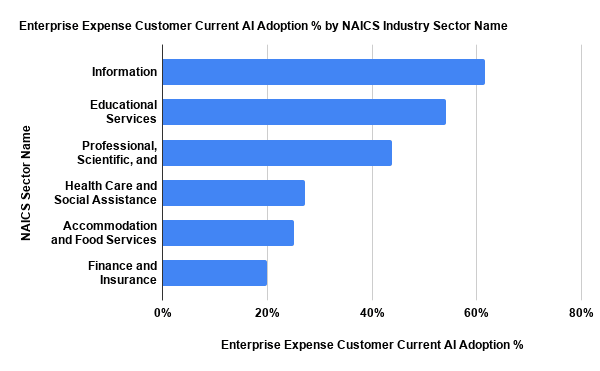
Information and education lead the benchmark at 22% of enterprise customers with AI spend, followed by professional services at 18%, financial services at 12%, and healthcare at 10%. Knowledge-heavy, decentralized industries move first. Regulated sectors move more carefully, not because they’ll skip AI, but because their path to scale runs through governance, data controls, and evidence of reliability before anyone signs off on wider use.
What should finance leaders do now?
Here’s where to start, mapped to the same muscle you already use to govern travel, expense, AP, and card spend.
| Decision area | Executive question | Recommended action |
|---|---|---|
| Ownership | Who owns AI spend when it shows up in both invoices and employee expenses? | Name a cross-functional AI spend owner across finance, IT, procurement, and security. |
| Governance | Which employee-purchased tools are becoming business-critical? | Review recurring, expense-driven AI tools and migrate approved use cases into governed contracts. |
| Vendor strategy | Are we dependent on one model provider or one workflow platform? | Track top-one, top-three, and top-five vendor concentration alongside every contract renewal. |
| ROI | Which AI spend supports a measurable workflow? | Separate experimentation, production workflow, and infrastructure spend in reporting. |
| Security and data | Which AI tools touch sensitive customer, employee, or financial data? | Tie AI approval to data classification, retention, and model-use policy. |
Where enterprise AI spend goes from here
AI hasn’t become a large line item everywhere. It hasn’t. The stronger conclusion is that AI has become recurring, broader, and more operational, and adoption is deepening faster among the customers who already use it than it’s spreading to new ones. Once a technology behaves that way across customers, vendors, categories, and workflows, it earns the same executive discipline as any other enterprise platform.
The next phase comes down to five moves. Identify recurring AI usage. Consolidate approved vendors where it improves control. Preserve flexibility while the market keeps moving. Measure workflow-level ROI instead of tool-level adoption. And bring employee-led AI tools into a governed operating model before they turn into invisible infrastructure.
AI is now one more category of spend you have to see clearly and control in real time, the same expectation you already hold for travel, expense, AP, and payments. That’s the discipline behind Emburse Expense Intelligence, the lens Emburse gives finance teams to see spend, including fast-moving new categories like AI, and govern it before it becomes unmanaged risk.
If AI is already showing up in your expense reports and invoices and you can’t yet say where, that’s the gap worth closing first.
Frequently asked questions
What share of enterprises have recurring AI spend?
48% of eligible enterprise customers showed recurring AI spend as of the latest month in the Emburse AI Index. Across the full study period, 45% of customers met Emburse’s definition of sustained AI adoption, up from 37% three years earlier.
Is Anthropic or OpenAI the top AI vendor for enterprises?
Anthropic overtook OpenAI as the top AI vendor by total enterprise expense spend in the most recent quarter tracked by the Emburse AI Index. More than 90% of Anthropic’s growth came from companies with 5,000 or more employees. OpenAI still holds a large share of cumulative spend over the full study period, and the vendor leaderboard has moved before and is likely to move again.
What percentage of AI spend goes to foundation models versus AI agents?
Foundation models and APIs account for 44.6% of tracked AI category spend. AI agents and workflow applications account for another 37.5%. Together, the two categories make up 82% of enterprise AI budgets, with infrastructure, coding agents, retrieval tools, and media generation splitting the remainder.
Are enterprises using one AI vendor or several?
Most are using several. Roughly half of active AI customers now use two or more named AI vendors in a given month, and multi-vendor use keeps climbing even as spend consolidates around a small group of leading providers.
How should finance teams govern AI spend?
Start by naming a cross-functional owner across finance, IT, procurement, and security. Track spend by category and vendor, migrate recurring employee-purchased tools into governed contracts, separate experimentation from production workflows in reporting, and tie AI approval to data classification and retention policy.
Methodology
This analysis is based on anonymized, aggregated Emburse enterprise expense and invoice data, classified using vendor and spend-category rules built to filter out false positives. Customers without enough transaction detail are excluded so the numbers reflect usable data.
One limit is worth naming directly. This doesn’t capture free AI tools, personal accounts used for work, or AI bundled into other software, so actual usage is likely higher than what shows up here.