

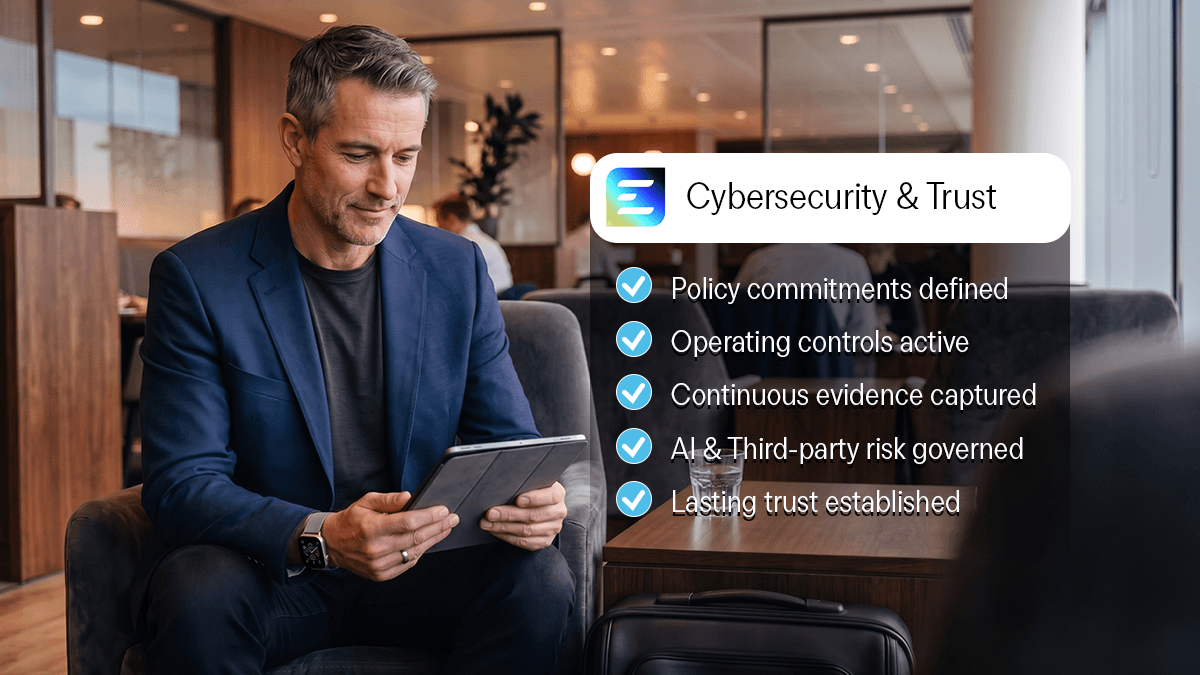
At Emburse, cybersecurity is more than point-in-time activity or a set of promises on a website. It is a continuous practice: understanding where risk is changing, building safeguards into the way we work, preparing to respond when something goes wrong, and learning from what we find.
Compliance is a critical part of that practice. Our assurance portfolio, including SOC 1 and SOC 2, PCI DSS, ISO/IEC 27001, ISO/IEC 27701, ISO/IEC 42001, and Tx-RAMP, provides meaningful external evidence of our commitment across security, financial controls, payment data, privacy, AI governance, and public-sector requirements. But these attestations, certifications, and authorizations are not the finish line. They reflect the discipline of a security program designed to operate every day.
Security is the mission. Controls make it repeatable.
The goal of cybersecurity is straightforward: reduce risk and protect what customers entrust to us. In practice, that means protecting sensitive data, limiting access appropriately, building securely, preparing for incidents, and keeping critical business processes resilient.
Controls make that work reliable rather than aspirational. They turn security expectations into actions that people and systems can follow consistently.
I find it helpful to think of this in three layers:
- A policy is the commitment: what we say we will do and why.
- A control is the repeatable mechanism that makes the commitment real, such as an access review or a change-approval step.
- Evidence is the proof that the control operated as intended: a record, report, ticket, or review that an owner can point to.
A policy without an operating control is an intention. Without evidence, a control is hard to verify. Together, they create the accountability that helps security work at scale.
This is where compliance adds real value. Standards and assurance requirements provide structure, common language, and independent scrutiny. They help organizations demonstrate that important controls exist and are operating. But an audit is a snapshot. Security is a habit.
Everyday assurance is how to stay ready
The most important security work does not begin when an auditor arrives. It happens through an operating rhythm of clear ownership, regular review, testing, and remediation.
At Emburse, we focus sustained attention on the safeguards that can reduce the impact of an issue: identity and access management, protection of sensitive data, secure development and change management, incident readiness, and oversight of the third parties that support our business. We also reassess risk as our products, business processes, regulatory obligations, and threat landscape evolve.
This matters because being compliant is not the same as being secure. Compliance establishes a valuable baseline, but it is not a ceiling. The more important question is continuous: given the way our business and threats are changing, are our safeguards still effective and proportionate?
And security is not just about preventing an event. Resilience matters too. Teams need to detect potential issues, respond with clarity and urgency, recover responsibly, and learn from every meaningful signal. Customer trust depends on that full lifecycle.
The strongest controls work with people
Technology is essential, but it cannot create an effective security program on its own. A safeguard that is difficult to use invites workarounds, leaving an organization with the appearance of security without its substance.
People make controls real. Training and awareness matter, but the greatest value shows up in daily decisions: someone questioning an unusual request, making a careful access decision, recognizing a potential risk, or reporting a mistake or suspicious message early. The strongest security cultures are those where employees understand their role in protecting customers and feel empowered to raise concerns.
Cybersecurity extends across our ecosystem, and into AI
Security does not stop at an organization's walls. Vendors and service providers that support our business are part of our risk surface, which is why third-party risk management requires ongoing attention, not a one-time procurement checklist. It means understanding how a partner may access systems or data, evaluating the relevant risk, setting clear expectations, and maintaining appropriate oversight throughout the relationship.
The same principle of embedded governance applies to artificial intelligence. As AI becomes part of how businesses operate and deliver value, it needs clear ownership, risk assessment, accountability, appropriate data protections, human oversight, and ongoing evaluation.
That is why Emburse's ISO/IEC 42001 certification matters. It demonstrates that our governance is evolving with the technology. I see AI governance as an extension of our overall cybersecurity and trust posture, not a separate or looser discipline. The same instinct that says that the control worked, does not simply say it exists, applies just as much to AI as it does to any other part of a security program.
Trust is earned in the work
Our security assurance portfolio matters because customers and partners deserve evidence, not just claims. But the certifications and attestations are most meaningful when they represent how work is actually done.
This Cybersecurity Awareness Month, I encourage organizations to focus on four essentials:
- Assign ownership. Every important control needs a named owner accountable for its operation, not just its documentation.
- Document evidence as you go. If evidence has to be reconstructed after the fact, the control was not really running.
- Stay ready, not just compliant. Review, test, and improve controls as risk changes; prepare to detect, respond, and recover.
- Build security and governance in early. Whether adopting a new product, vendor, or AI capability, the right time to address risk is during design, not after deployment.
Cybersecurity earns trust through consistent action. When security is embedded in people, processes, technology, and innovation, compliance becomes more than a badge. It becomes evidence of a durable commitment to protecting customers and enabling responsible growth.