

This week, I had the opportunity to take part in AI Congress Barcelona, where I was invited to share Emburse’s experience in a session focused on governance, regulation, and technological sovereignty in large-scale artificial intelligence systems.
Over the past few years, we have seen AI evolve from an experimental technology or a simple accelerator into a core component of many business products and processes.
In my talk, I used Emburse Assurance, our AI solution for fraud detection and expense-policy compliance, as a practical example of a challenge we know well: moving from a compelling demonstration to a system that can operate every day across millions of documents and real financial decisions.
If I had to summarize the talk in one idea, it would be this:
Scaling AI is not simply about processing more information. It is about building systems that remain reliable, efficient, and governable as everything grows.
The challenge: millions of expenses, thousands of policies, and too many exceptions
Corporate expense management may seem straightforward: an employee submits an expense, attaches a receipt, and a manager approves it. But substantial complexity sits behind that process.
Every company has its own policies, limits, restrictions, and exceptions, which can vary by country, department, or the circumstances of an expense. Add to this millions of documents in different languages, currencies, and formats, plus information distributed across multiple systems.
Traditionally, organizations have relied on deterministic rules, manual reviews, and sample-based audits. This model is difficult to scale and, above all, reactive: many issues are identified only after the expense has already been approved or reimbursed.
AI makes it possible to change that paradigm: automatically analyze every transaction, interpret its context, and identify potential violations before they become a problem.
Emburse Assurance: intelligence embedded where decisions are made
At Emburse, we believe the real value of AI emerges when it is integrated directly into business processes, rather than added as an isolated feature.
That is the philosophy behind Emburse Expense Intelligence, which brings intelligent capabilities across the entire travel and expense lifecycle: from document capture and booking through approval, auditing, payments, and analytics.
Emburse Assurance is one capability in this ecosystem, designed to proactively identify errors, anomalies, policy violations, and potential fraud.
More than reading a receipt
Imagine a restaurant receipt that includes an alcoholic drink. A traditional OCR system may accurately extract the text from the document, but that is not enough.
To determine whether there may be a policy violation, the system needs to understand which product appears on the receipt, identify it as alcohol, know the company’s specific policy, and evaluate the context of the expense.
It may also need to verify whether the merchant is legitimate, whether there are signs of receipt manipulation, or whether the transaction has unusual characteristics.
This requires combining different technologies: computer vision, classification models, deterministic rules, and contextual analysis.
One of our most important lessons is that not everything needs an LLM. The best architecture uses the right technology for each problem.
Assurance combines immediate checks before an expense is submitted with deeper analyses that run asynchronously, balancing accuracy, performance, and user experience.
The real challenge: bringing AI to scale
Our document-processing platform handles more than one million documents every day. And a document does not necessarily equal a single decision: one transaction can trigger multiple checks, models, and business rules.
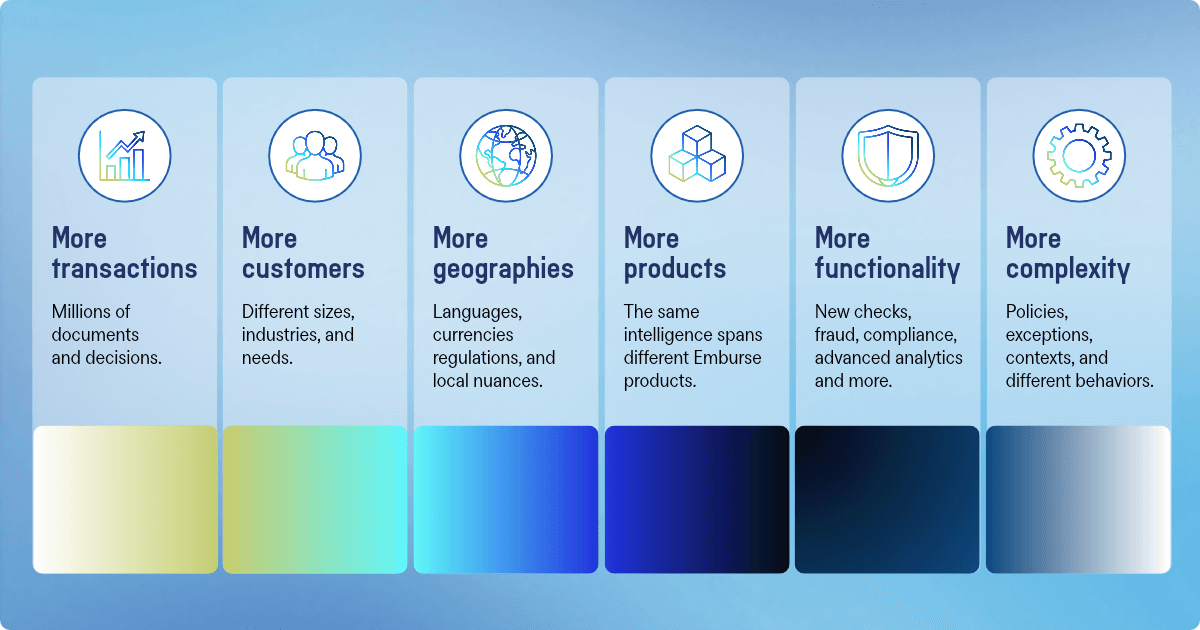
As we add new customers, products, geographies, and capabilities to that volume, complexity grows quickly.
For many years, I have emphasized one idea: scaling is not simply about adding more servers. A system that works with ten documents per hour is not necessarily ready to process one million.
With AI, the classic principles of scalability remain essential, but new challenges emerge around reliability, cost, technological evolution, and regulation.
1. Designing AI architectures for change
AI models, providers, and technologies evolve constantly. That is why we need to avoid architectures that are overly dependent on one specific solution.
Assurance uses a modular architecture based on independent validation units that we call checks. Each can incorporate different technologies and evolve without rebuilding the entire system.
The model will change. The provider will change. The volume will change. The architecture has to account for that from the outset.
2. AI reliability is not measured by availability alone
One of the most important lessons we have learned while operating AI systems is that their behavior can degrade without any obvious technical failure.
A service can remain technically operational while making increasingly incorrect decisions.
In our experience with document-processing platforms, we have had to respond to changes in the quality of external models and services. That has led us to evaluate alternatives and reinforced the importance of observability.
It is not enough to measure latency, availability, or technical errors.
We also need to monitor the quality of outcomes, false positives, false negatives, and potential changes in model behavior.
“An HTTP 200 (successful response) does not mean the AI made a good decision.”
3. The economics of AI must scale too
Cost is a dimension that is often left out of technical demonstrations.
At a small scale, a few cents per operation may seem irrelevant. When we process millions of documents, those cents can have a considerable economic impact.
That is why we analyze unit cost per document or decision, seeking the right balance among accuracy, latency, and cost.
Using the most powerful model every time is not necessarily the best choice. Sometimes, a deterministic rule or a specialized model solves the problem more quickly, economically, and predictably.
The most technically sophisticated solution is not always the best business solution.
4. Regulation also shapes the architecture
Scaling globally does not simply mean deploying the same system in more countries.
Privacy, data residency, and regulatory requirements can impose important architectural constraints.
At Emburse, we have had to account for different processing regions in Europe and the Americas, adapting our architecture to the protection and processing needs of sensitive financial information.
Technological sovereignty does not necessarily mean developing every technology in-house. It means retaining control over data, decisions, and technology dependencies.
Governing decisions, not only models
When a system uses artificial intelligence to make financial decisions, governance stops being a secondary consideration.
It is not enough for the system to work.
We need to be able to trust its decisions.
At the AI Congress, I raised five questions that I consider fundamental for any AI system in production.
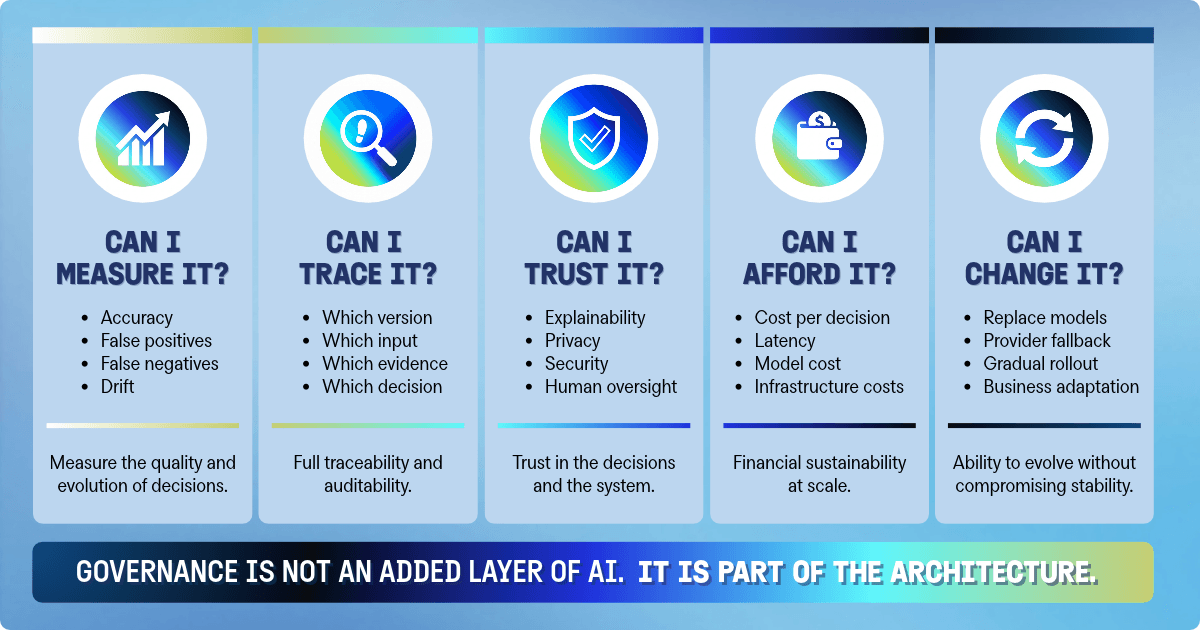
- Can I measure it? Can we measure the quality of decisions and detect when it starts to degrade?
- Can I trace it? Can we reconstruct which model, version, information, and evidence were involved in a decision?
- Can I trust it? Can we ensure the necessary controls for privacy, security, explainability, and human oversight?
- Can I afford it? Can we sustain the system economically as volume multiplies?
- Can I change it? Can we replace models, add providers, or deploy new versions without compromising stability?
These questions must shape architectural decisions from the beginning, not be raised only once the system is already in production.
An example: detecting fraud without compromising privacy
One of the challenges we are exploring in Assurance is detecting duplicate receipts across different companies. Identifying that two employees from different organizations have submitted the same receipt could significantly improve the detection of potential fraud.
However, this raises an important challenge: how can we use global intelligence without compromising the privacy or data isolation of each customer?
It is a good example of why innovation and governance must move forward together. The more data we connect, the more intelligence we can generate, but the greater our responsibility for how we use it.
The next revolution is not simply about using more AI
At Emburse, we are applying artificial intelligence to real financial processes, integrating it into our products and progressively expanding its reach.
But our experience shows that innovation does not end once we make a model work. We need to design systems that can grow, evolve, and operate reliably and responsibly.
AI enables us to scale what we do. Engineering and governance enable us to scale AI itself.
The real challenge is not making artificial intelligence work. It is making sure we can trust it when it works at scale.