Real Estate Agent Expense Tracking: Keep the Details in 2026
Real estate agent expense tracking involves recording business expenses, linking them to the relevant listings or transactions, and tracking who ultimately pays for them. From property photography and staging to mileage and marketing, these costs can add up long before a sale closes.
Keeping accurate records helps agents and brokerages understand what each listing costs, track reimbursements and commission deductions, and maintain the documentation needed for accounting and tax reporting. Learn how to improve real estate agent expense tracking with financial tools that keep your records accurate and up-to-date.
Track expenses against each listing from the start
Agents pay costs before earning commissions, and some listings generate no commission. Real estate agents often pay for photography, staging, marketing, and other services before a property sells. Some listings may never close, making it important to record expenses against the relevant property or transaction as they occur.
Consider two March photography invoices: one listing closes in June, while the other expires in May. The invoices look identical. Without recorded context, later explanations may depend on the agent’s or photographer’s recollection. Tracking each expense against its respective listing helps agents see how much they've invested in each property, including those that generate no commission.
NAR’s 2026 Member Profile measures what surveyed REALTORS® spend on their businesses. It reports these medians:
- Total business expenses had a median of $9,530 in 2025, up from $8,010 in 2024.
- Vehicle costs had the highest category median, at $1,580.
- No other listed expense category, including marketing, dues, and technology, had a median above $1,100.
These are self-reported medians for surveyed REALTORS®, not all real estate agents, and they are not tax data.
Worker status decides who can deduct what
Whether a real estate agent can deduct business expenses depends partly on their employment status. Self-employed agents and brokerage employees follow different federal tax rules.
The IRS generally treats licensed real estate agents as self-employed for all federal tax purposes when two conditions hold:
- Substantially all pay relates directly to sales or other output rather than hours worked
- A written services contract states they will not be employees for federal tax purposes
Under IRC 3508, both conditions must be met for this treatment to apply.
For agents who are brokerage employees,these rules govern unreimbursed job expenses:
- The One, Big, Beautiful Bill Act made the disallowance of miscellaneous itemized deductions permanent
- Employees generally cannot itemize unreimbursed job expenses, with a limited exception for certain educator expenses
- Specified groups, such as qualifying reservists, may qualify for separate above-the-line deductions
For an employee-agent, brokerage reimbursement is the practical route to recovering eligible business costs.
Brokerage finance teams also need to track how expenses are paid and recovered, including when the brokerage:
- Pays vendors directly
- Reimburses agent-paid expenses
- Deducts expenses from agent commissions
An agent's records have to agree with these brokerage records.
United States federal tax rules and state recordkeeping requirements can differ. Apply the named state examples only where relevant. Confirm your arrangement with a CPA.
Ask three questions about every expense
A category such as marketing records what was bought. Whose money it was, which listing it helped, and who ultimately pays need their own fields.
This practical framework, which is not an IRS or accounting standard, adds these three answers to each record:
- Who paid: Identify whose funds paid first—the agent's personal card, the agent's business account, the brokerage, a team account, or a client
- What business activity benefited: Identify the listing, buyer transaction, campaign across several listings, general operations, or personal activity
- Who ultimately bears the cost: Identify whether the agent, brokerage, client, or a combination of them is responsible for the expense, which may differ from who initially paid or isn’t known on the day of purchase
A later settlement event can determine the answer to the third question. This may be reimbursement, a commission deduction, repayment at closing, or no repayment. Record that event when it happens against the same listing, so the accountant can identify who ultimately bore the cost and update the records.
How are expenses paid and settled?
The same $400 listing photography invoice can settle five different ways, depending on who pays first and who ultimately bears the cost:
| Arrangement | Who paid | Who ultimately bears the cost | What to record |
|---|---|---|---|
| Agent pays and bears the cost | Agent | Agent | The expense with the invoice attached to the listing. No reimbursement or repayment is provided under this arrangement. |
| Agent pays, and the seller repays at closing | Agent | Seller, once repaid | The payment against the listing, then the repayment against the same listing when it arrives. How such a repayment is treated for tax depends on the arrangement, so a CPA should confirm it. |
| Brokerage pays and deducts the amount from the agent's commission | Brokerage | Agent, through the commission deduction | The listing reference on both the vendor invoice and the commission statement. The agent records the deduction, not just the net deposit. |
| Brokerage advances the cost, and the seller repays later | Brokerage | Seller, once repaid | The controller records the brokerage advance as a receivable. The balance remains until settlement. |
| Employee agent pays, and the brokerage reimburses | Agent | Brokerage | The payment and the reimbursement against the same expense, within the brokerage's accountable plan. |
Each arrangement ties the payment and any later settlement to the same listing. Outside terms decide when two of these arrangements settle:
- Historical brokerage advance: Compass’s 2021 program required repayment at the earliest of sale, listing termination, or one year after costs were funded.
- Current brokerage advance: Current Concierge terms use the earliest of sale, listing termination, or 12 months from the Concierge start date, subject to applicable loan terms which vary by market.
- Employee reimbursement: Under an accountable plan, the employee must account for the expense within a reasonable period. Substantiation within 60 days after payment or incurrence meets a Treasury safe harbor
Under an arrangement with repayment triggers, the controller needs listing status to know when a balance comes due, including for listings that never close.
How should expenses shared across listings be allocated?
Some spend serves more than one listing or purpose. Record the allocation for each case:
- Shared marketing: If one postcard campaign covers four listings, record the invoice once to document how the cost is divided, such as equal shares or by days on market
- Mixed personal and business use: For a phone or car used personally and professionally, record the business portion and how you calculated that share.
Apply a consistent allocation method and confirm its suitability with your CPA.
Which dates should you record for each expense?
A listing’s record needs more than the purchase date. Record three dates for each expense:
- The date you paid
- The date the business activity occurred
- The date the related transaction closed or the listing ended
The closing date is what lets you compare what a listing cost with what it earned. A listing that never closes still keeps its expenses on its own record. Your accountant decides which date determines the tax year, because that depends on your accounting method.
State recordkeeping rules may also affect how long you need to retain these records. California, for example, requires brokers to keep transaction documents for three years and starts the clock on the listing date when a transaction is not consummated.
What proof to keep for each expense
For travel, gift, and car expenses, the IRS expects a record and documentary evidence. You can use an account book, diary, log, or similar computer record under IRS recordkeeping rules. The IRS distinguishes two forms of proof:
- A written or computer record identifies the expense and its business context
- Receipts, canceled checks, or bills supply documentary evidence
An unsupported approximation is insufficient. Contemporaneous records carry more weight than reconstructions.
Expenses subject to IRC 274(d) require substantiation for travel, gifts, and listed property such as vehicles. The required details include:
- Amount of the expense
- Time and place
- Business purpose.
- Recipient's relationship to your business, for gifts
Tie each expense to the relevant transaction and record the required details. A card statement line has the same gap as a canceled check, which the IRS says does not prove business purpose by itself.
For example, a restaurant receipt shows how much an agent spent but doesn't explain why the meal was business-related. A note reading "coffee with buyer client before the Oak Street showing" next to a transaction ID does what a receipt cannot.
Some expenses qualify for IRS documentary evidence exceptions. Receipts or other documentary evidence are not required for these expenses:
- Nonlodging expenses below $75
- Transportation expenses when a receipt isn’t readily available
The written record of the expense is still needed. Build applicable IRS receipt requirements into your receipt management process, while retaining the separate business-purpose record.
Mileage records also need accurate trip dates, particualrly because the IRS business standard mileage rate changed during 2026:
- January 1 – June 30: 72.5 cents per mile
- July 1 – December 31: 76 cents per mile.
A log with trip dates lets your accountant apply the right rate to each trip. The standard rate is optional; taxpayers may instead substantiate actual allowable vehicle expenses with adequate records.
Keep categories, attribution, and personal spending separate
Categories and attribution answer different questions. Keep these accounting fields separate:
- Use your accountant’s category list to classify the purchase
- Record the listing and payer in their own fields
A single “Marketing” category cannot also preserve listing-level attribution. Use that distinction when tracking small business expenses, keeping transaction context alongside the accounting category.
When possible, pay business expenses from a dedicated card or account. Flag purchases paid from a personal card as personally paid. This identifies amounts owed back and the responsible payer.
A tracking table for common real estate expenses
Common real estate expenses differ in who pays, which listing or transaction benefits, and who ends up bearing the cost. A single category label cannot hold all three answers. Deductibility also depends on worker status, brokerage terms, and tax-year treatment, so confirm those details with a CPA.
Use the example table below as a reference, alongside the three questions covered earlier: who paid, which business activity benefited, and who ultimately bears the cost.
| Expense type | Evidence to capture | Suggested tracking example | Common mistake |
|---|---|---|---|
| Business mileage to a showing | Trip date, starting point, destination, miles driven, business purpose, and the property or client | Paid by: AgentActivity: Listing or buyer transactionBearer: Agent, unless a brokerage reimbursesMileage rate: Applicable IRS or company rate | Rebuilding a month of trips from memory at year-end, or applying one rate to all of 2026 |
| Listing photography | Vendor invoice, proof of payment, listing address, payment date, and any repayment terms | Paid by: Agent or brokerage Activity: Specific listingBearer: Agent, brokerage, or seller, depending on the settlement eventSettlement event: Seller repayment, commission deduction, reimbursement, or none | Failing to record a later repayment, leaving a cost on the books that someone else covered |
| Staging or home-prep services | Contract or invoice, listing reference, payer, plus any repayment terms | Paid by: Agent, brokerage, or sellerActivity: Specific listingBearer: Determined by the agreement and the repayment triggerRepayment trigger: Sale, listing termination, or contractual deadline | Assuming the initial payer is the bearer, when some advance programs require repayment upon a sale, listing termination, or a 12-month deadline |
| Marketing across several listings | Invoice, campaign dates, listings covered, and allocation method. | Paid by: The actual payerActivity: Several listingsBearer: Agent, brokerage, or sharedAllocation: Equal shares, campaign spend per listing, or another documented basis | Charging the full invoice to the first listing, distorting each listing’s results |
| Client meal | Receipt, date, place, amount, attendees, relationship to the business, business purpose, and related transaction | Paid by: AgentActivity: Buyer transaction or listing Bearer: Agent | Keeping only the receipt without documenting the guests and business purpose |
| Closing gift | Receipt, recipient, relationship to the business, date, description, and transaction | Paid by: Agent or brokerage Activity: Specific closingBearer: Agent or brokerageRecipient: Buyer or sellerAnnual recipient total: Cumulative gift amount | Transaction-only tracking omits recipient totals. Business gifts to one person generally face a $25 annual deduction limit, subject to applicable rules and exceptions. |
| Licensing, dues, and education | Invoice or statement, amount and period covered | Paid by: Agent or brokerageActivity: General operationsBearer: Agent or brokerageListing reference: Not applicable | Assigning recurring dues to an unrelated listing, inflating that listing’s costs |
| Software subscription | Subscription invoice, plan period, account owner, and apyment method | Paid by: Cardholder Activity: General operations or a shared team accountBearer: Agent, brokerage, or teamAccount owner: Named subscriber or administrator | Reimbursing multiple people for the same team plan because account ownership isn’t recorded |
| Mixed-use phone or vehicle cost | Bill or statement, business-use percentage, and the method used to calculate it | Paid by: Agent or brokerage Activity: General operations Bearer: Agent or brokerageBusiness-use share: Documented percentage or mileage-based calculation | Assuming the full bill is a business expense simply because it was paid from a business account |
| Personally paid expense reimbursed by the brokerage | Receipt, related listing or activity, submission date, approval date, and reimbursement date | Paid by: AgentActivity: Related listing, transaction, or general operationsBearer: BrokerageSettlement event: Reimbursement | Submitting late; for employees under an accountable plan, the 60-day safe harbor runs from the date the expense was paid or incurred |
| Brokerage fee deducted from a commission | Commission statement showing each deduction, transaction ID, and any related vendor invoice | Paid by: Agent, through commission deduction Activity: Related transaction Bearer: AgentDeduction type: Brokerage fee, marketing charge, or repayment of an advance | Recording only the net deposit and omitting the fee line items from the books |
| Expense on a listing that never closes | Original expense records, listing reference, listing dates, and final status (expired, withdrawn, or terminated) | Paid by: Agent or brokerage Activity: Specific listingBearer: Agent, brokerage, or seller, depending on agreementListing status: Expired, withdrawn, or terminatedSettlement event: Any repayment owed when the listing ends | Relabeling the expense as general overhead, erasing the listing’s recorded cost |
Preserve both the original purchase and later settlement so listing costs reflect who ultimately paid. Even when the initial payer and final cost bearer are the same, record both so you can consistently track who paid, identify outstanding reimbursements, and avoid double-counting expenses.
How to keep real estate expense records up to date
Keeping expense records accurate is easier when you update them throughout the transaction, rather than trying to reconstruct everything at month-end or tax time.
Update your records at these points:
- At purchase: Photograph the receipt, tag the listing, and record the business purpose
- Weekly: Reconcile card and bank feeds with your records, and fix anything untagged or missing
- At closing, termination, or reimbursement: Record the settlement event, any repayments or commission deductions, update the listing's status, and flag outstanding amounts
- Monthly: Review what sits in "general", check whether any of it belonged to a listing, and follow up on any outstanding settlements
- When your Form 1099-NEC arrives: Compare it against your commission statements and document any difference and explanation before sending the records to your accountant
Independent agents can personally manage these records. For teams or brokerages, assign one person to track open settlements and confirm each outcome with the agent.
Finance teams paying listing vendors should track covered service payments totaling $2,000 or more per payee per calendar year, for payments made after December 31, 2025. Form 1099-NEC reporting also depends on payee and payment method, so confirm the applicable reporting route with your tax advisor.
Make real estate expense tracking easier with Emburse Spend
When you're managing multiple listings, keeping expense records up to date shouldn't mean chasing receipts, sorting through card statements, or reconstructing costs after a property closes. With the right setup, your team can spend less time preparing information for accounting and tax reviews and focus more on closing.
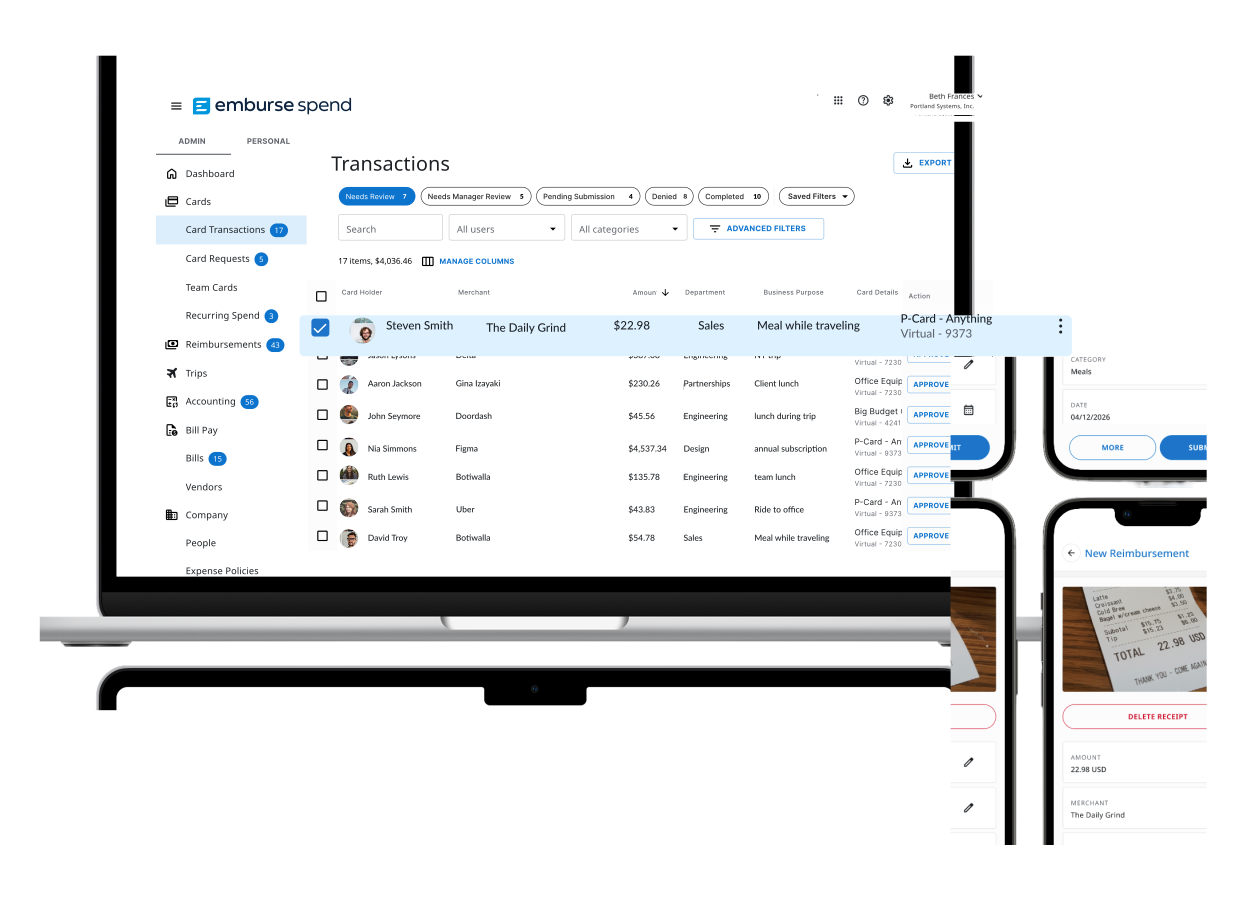
Emburse Spend helps independent agents and growing brokerages capture and organize expenses as they happen, so you can:
- Keep listing expenses organized
- Spend less time matching receipts to purchases
- Track business mileage more easily
- Apply consistent spending rules
- Simplify accounting
Frequently asked questions
Keep the expense on the listing’s record, with the same evidence as a completed sale:
- Retain the invoice and proof of payment
- Keep the business-purpose note
- Record whether the listing expired, was withdrawn, or was terminated
The listing outcome provides context without erasing its cost.Do not move the cost to general overhead, because that hides what the listing actually cost. If a brokerage or client owes repayment when the listing ends, record that settlement event too.
Keep records supporting a tax-return item until the applicable period of limitations expires. The IRS periods vary with the return and record type:
- The general period is 3 years after the return is filed
- The period extends to 6 years if you omit more than 25% of the gross income shown on the return
- Bad debt or worthless securities claims have a 7-year period
- Keep records indefinitely for an unfiled or fraudulent return.
- Retain employment tax records for at least 4 years after the tax is due or paid, whichever is later
- Refund claims generally require records for 3 years after filing or 2 years after payment, whichever is later
- Property records can require longer retention to establish basis and the later tax treatment
Keep the applicable tax period separate from the brokerage’s state obligations.
California requires 3 years from closing, or from the listing date if the transaction is not consummated. Texas requires at least 4 years from closing, termination, or the end of the transaction for records that include receipts and disbursements of compensation. Ask your brokerage which rules apply.
A real estate mileage log needs a contemporaneous entry for each business trip. Each entry should record the details Publication 463 lists for car expenses:
- Trip date and starting point
- Business destination and miles driven
- Business purpose and the property or client
Also retain the total miles for the year. For 2026, the trip date also determines the rate, because the IRS business rate was 72.5 cents per mile through June 30 and 76 cents from July 1. Entries made at or near the time of the trip carry more weight than a reconstruction.
Keep every commission statement with its transaction ID, then compare the total you were paid with the Form 1099-NEC when it arrives. Write down any difference and what explains it, such as a split, a fee, or an adjustment.
Ask the brokerage how it reports commissions and fees, and give your CPA both the form and the statements.
Employee agents are the ones who need an accountable plan, because it is an employer reimbursement arrangement. A self-employed agent has no employer plan to follow.
Qualification depends on how the arrangement works. An accountable plan must meet three requirements:
- Expenses have a business connection
- The employee adequately accounts for them within a reasonable period
- The employee returns excess reimbursement within a reasonable period
All three conditions are necessary for accountable-plan treatment. The fixed-date reasonable-period safe harbor covers an advance within 30 days of payment or incurrence, substantiation within 60 days, and return of excess within 120 days. These safe harbors are not the only way to establish a reasonable period.
When a payer repays a self-employed agent's expenses, Publication 463 asks whether the agent gave the payer adequate records.
Emburse Spend helps independent agents and growing brokerages capture and organize expenses as they happen by:
- Capturing receipts and transaction details at the point of purchase, with expense categories and references to the relevant listing or transaction
- Providing automatic receipt matching and support for existing corporate card programs
- Tracking business mileage with manual or GPS-based mileage entry and reimbursement rates configured to your expense policy
- Applying consistent automated spending rules, policy checks, and approval workflows
- Connecting approved expense data with supported accounting systems
Before setting up your workflows, confirm with your bookkeeper or accountant that the required fields—such as listing references, payer information, and settlement status—can be captured and transferred to your accounting system.